


The Worm Ouroboros
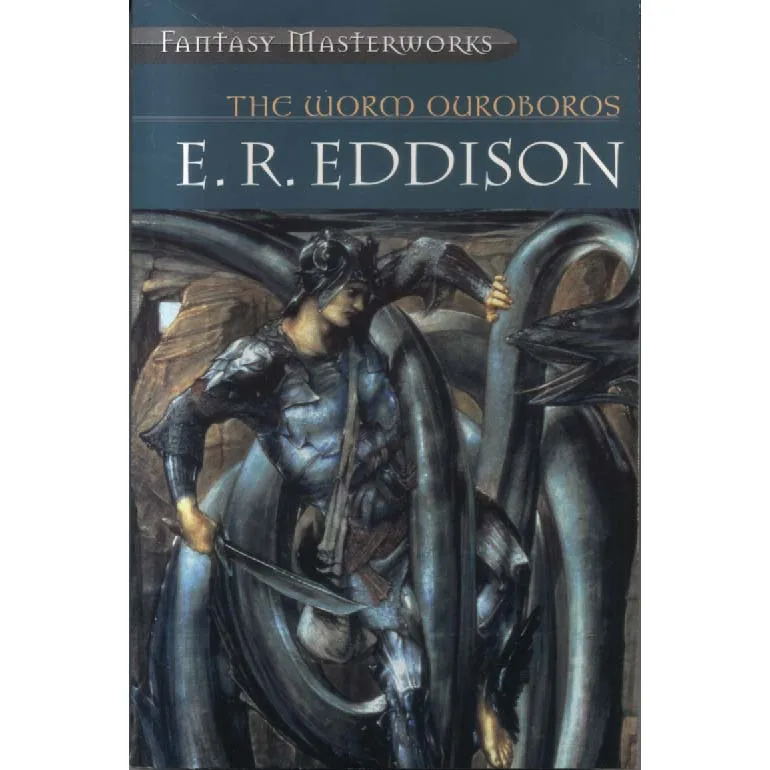
Publisher: Millennium
Format: Paperback
ISBN: 9781857989939
The Worm Ouroboros (2000) by Eric Rucker Eddison
Millennium
ISBN: 9781857989939
Condition: Good
Before fantasy fiction became crowded with farm boys, magical schools, reluctant heirs and maps containing suspiciously many mountain ranges, there was The Worm Ouroboros.
First published in 1922, Eric Rucker Eddison’s great sprawling fantasy is one of the genre’s genuine early landmarks: an enormous, extravagant tale of war, heroism, sorcery, rivalry and magnificently excessive language, set in a world populated by characters who behave as though ordinary conversation would constitute a serious failure of imagination.
The story concerns the long struggle between the heroic lords of Demonland and the ambitious King Gorice of Witchland, although anyone expecting demons in the modern supernatural sense may be surprised. Eddison’s peoples are essentially heroic fantasy races, distinguished more by allegiance and temperament than by horns, tails or an unfortunate smell of sulphur.
What follows is a grand conflict involving battles, voyages, sieges, intrigue, magic and heroic declarations delivered with enough grandeur to make an ordinary sentence feel inadequately dressed.
Eddison writes as though the English language has been issued with ceremonial armour.
The prose is famously ornate, drawing heavily on Elizabethan and Jacobean styles, and the characters speak with a magnificent seriousness that suggests nobody in Demonland has ever said, “Fair enough, see you Tuesday.”
Instead, warriors announce their intentions in rolling speeches, enemies exchange elaborate threats, and every important event sounds as though it ought to be accompanied by trumpets.
This is very much part of the book’s appeal.
The Worm Ouroboros does not attempt realism. It does not contain weary civil servants completing supply forms for the Demonland army, nor does anyone appear particularly concerned about the administrative burden of maintaining several castles during prolonged military operations.
Instead, it gives itself completely to heroic fantasy: dangerous journeys, impossible landscapes, mighty champions, beautiful queens, terrible enemies and the notion that greatness is worth pursuing simply because greatness itself is magnificent.
There is also a curious dreamlike quality to the world. The setting is nominally Mercury, although anyone searching for astronomical accuracy should probably look elsewhere. Eddison’s Mercury bears roughly the same relationship to the actual planet as Camelot does to Milton Keynes.
Geography here exists primarily to provide somewhere dramatic for heroes to climb mountains, cross seas and fight each other.
The novel’s influence on later fantasy is substantial, and readers familiar with Tolkien and subsequent generations of epic fantasy may recognise elements of the grand tradition taking shape here. Eddison, however, has a voice entirely his own: richer, stranger and often far more theatrical than much modern fantasy.
Where a contemporary writer might describe a warrior entering a room, Eddison seems inclined to ensure that the warrior enters beneath banners while destiny itself pauses briefly to watch.
The title refers to the Ouroboros, the ancient symbol of a serpent or dragon consuming its own tail, representing cycles, eternity and renewal. It is an especially appropriate image for a novel concerned with conflict, glory and the strange desire of heroic people to continue doing heroic things even when tranquillity might be considerably more practical.
Practicality, admittedly, is not one of Demonland’s major industries.
This Millennium edition from 2000 brought Eddison’s remarkable fantasy back to readers at a time when epic fantasy was enjoying another great resurgence, making it an excellent opportunity to investigate one of the books that helped establish what the genre could become long before fantasy novels routinely arrived in twelve-volume sequences.
Readers who enjoy lush prose, mythic adventures, enormous battles and characters who regard understatement as a personal insult should find plenty to admire here.
It is not a quiet book.
It is not a modest book.
It is a book that arrives wearing a cloak, carrying a sword and expecting someone to compose a poem about it before dinner.
This copy is in Good condition, which is reassuring because after more than a century of battles between Demonland and Witchland, something around here ought to have survived intact.
Available from Crappy Old Books, where the eternal cycle continues: books arrive, books leave, and occasionally one turns up with enough fantasy grandeur to require its own herald.
Keep browsing: See more Fantasy books Other books by Eric Rucker Eddison
